
When you are dealing with a personal injury claim, financial pressure can build quickly. Medical expenses, household bills, transportation costs, and lost income may become difficult to manage while your case is still pending. This is where understanding how personal injury settlement funding differs from a bank loan can help you evaluate your available financial options.
Personal injury settlement funding, often called pre-settlement funding, is designed around a pending legal claim rather than traditional borrower qualifications. NEO Legal Funding explains that this type of funding can provide an advance against anticipated settlement proceeds while a personal injury case is unresolved.
Personal injury settlement funding is financial support provided to an eligible plaintiff while a personal injury claim is pending. Rather than waiting until the case concludes, an approved applicant may receive an advance based on the anticipated value of the claim.
The structure is different from conventional borrowing. According to NEO Legal Funding, personal injury funding is generally structured as non-recourse funding, meaning repayment is tied to a successful recovery in the case.
The most important distinction is the way repayment and eligibility are determined.
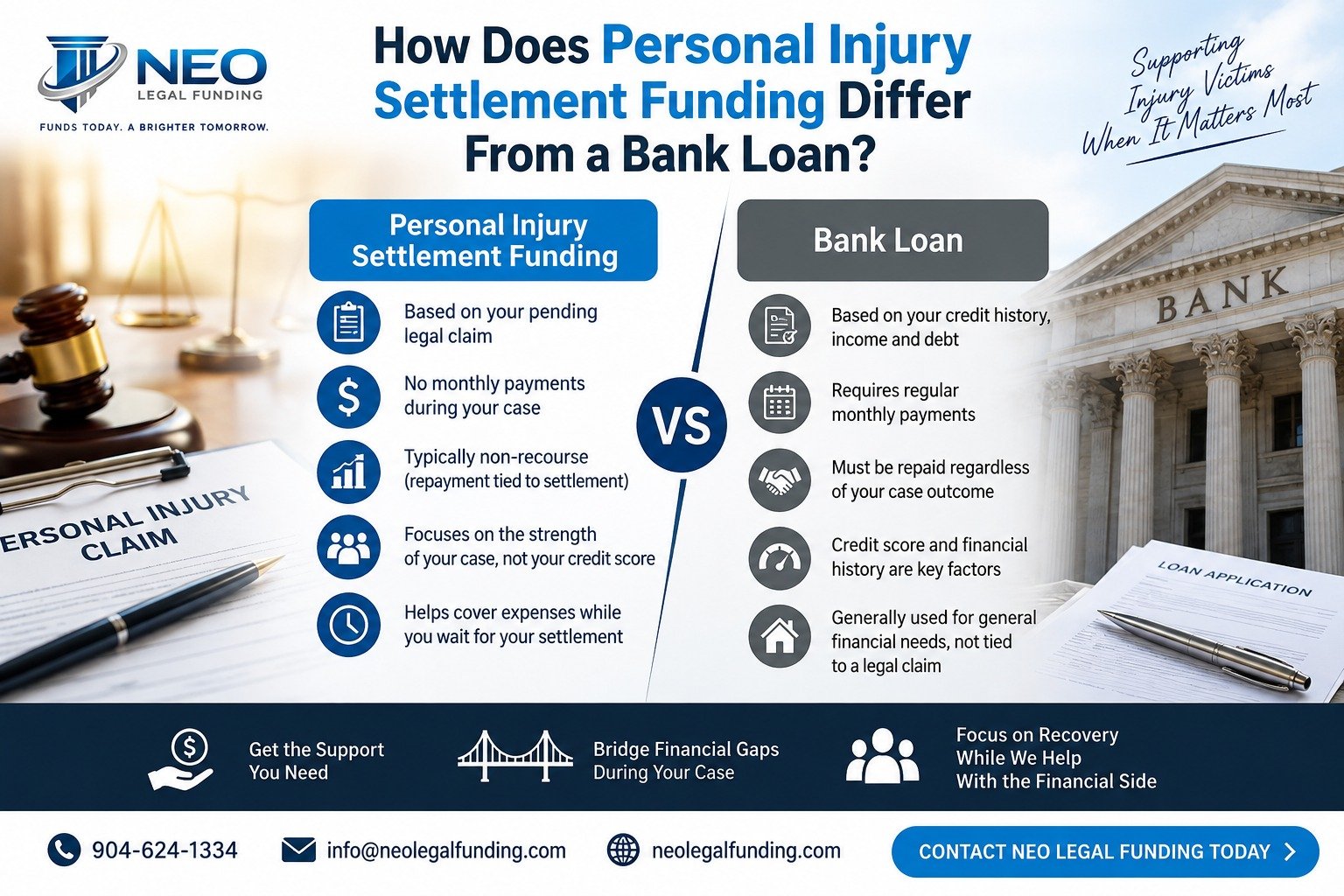
A traditional bank loan generally evaluates the borrower’s financial circumstances, which can include credit history, income, existing debt, and ability to make scheduled payments. Settlement funding instead focuses primarily on the underlying legal claim and its potential recovery.
Here are several important differences:
These differences are important because a funding advance can reduce the amount of money ultimately available from a settlement after repayment and applicable fees.
Imagine someone is unable to work after an accident and has several months of household expenses ahead of them. A traditional loan may create monthly repayment obligations regardless of what happens with the injury case.
With non-recourse settlement funding, repayment is generally connected to the outcome of the claim. However, the exact terms vary by agreement and jurisdiction, so applicants should understand the total potential repayment before proceeding.
Before accepting personal injury settlement funding, consider:
An attorney can explain how funding may interact with your specific claim and settlement.
People involved in car accidents, truck collisions, motorcycle crashes, slip-and-fall incidents, defective-product cases, medical malpractice claims, and other personal injury matters may explore pre-settlement funding. NEO Legal Funding lists several of these claim types among the cases for which funding may be available.
The question of how personal injury settlement funding differs from a bank loan ultimately comes down to structure, repayment obligations, eligibility considerations, and cost.
A bank loan is based on a lender-borrower relationship and normally requires repayment whether or not a separate legal claim succeeds. Settlement funding is connected to a pending claim and may be structured as a non-recourse advance.
Before making a decision, consider:
There is no single financial option that is appropriate for every injured person. The right approach depends on the individual’s circumstances, legal claim, financial needs, and the terms offered.
Understanding how personal injury settlement funding differs from a bank loan is an important step before considering either option. Settlement funding may provide access to money while a claim is pending, while a traditional bank loan generally creates a separate repayment obligation based on the borrower’s financial qualifications.
If you are considering funding for a personal injury case, review the agreement carefully and speak with your attorney about your specific circumstances. NEO Legal Funding provides information and funding options for eligible plaintiffs with pending personal injury claims.
For more information: NEO Legal Funding can be contacted at 904-624-1334 or info@neolegalfunding.com.
Frequently Asked Questions
Q1. How does personal injury settlement funding differ from a bank loan?
Personal injury settlement funding is generally connected to a pending legal claim and may be structured as non-recourse funding. A bank loan is normally based on the borrower’s creditworthiness and requires repayment under its loan terms.
Q2. Does personal injury settlement funding require monthly payments?
It may not require monthly payments in the same way as a conventional loan. Repayment is generally connected to the resolution of the legal claim, depending on the specific funding agreement.
Q3. Is settlement funding based on my credit score?
Legal funding providers generally focus on the underlying case rather than traditional credit-based lending criteria. However, eligibility and requirements vary between providers.
Q4. Can I use personal injury funding for everyday expenses?
Depending on the funding agreement, an advance may be used for expenses such as rent, groceries, transportation, medical costs, and household bills. NEO Legal Funding states that its funding can be used for various expenses while a lawsuit is pending.
Q5. Should I discuss settlement funding with my attorney?
Yes. Your attorney can help you understand your case and explain how a funding agreement may affect your potential settlement proceeds. Funding terms should also be reviewed carefully before signing.